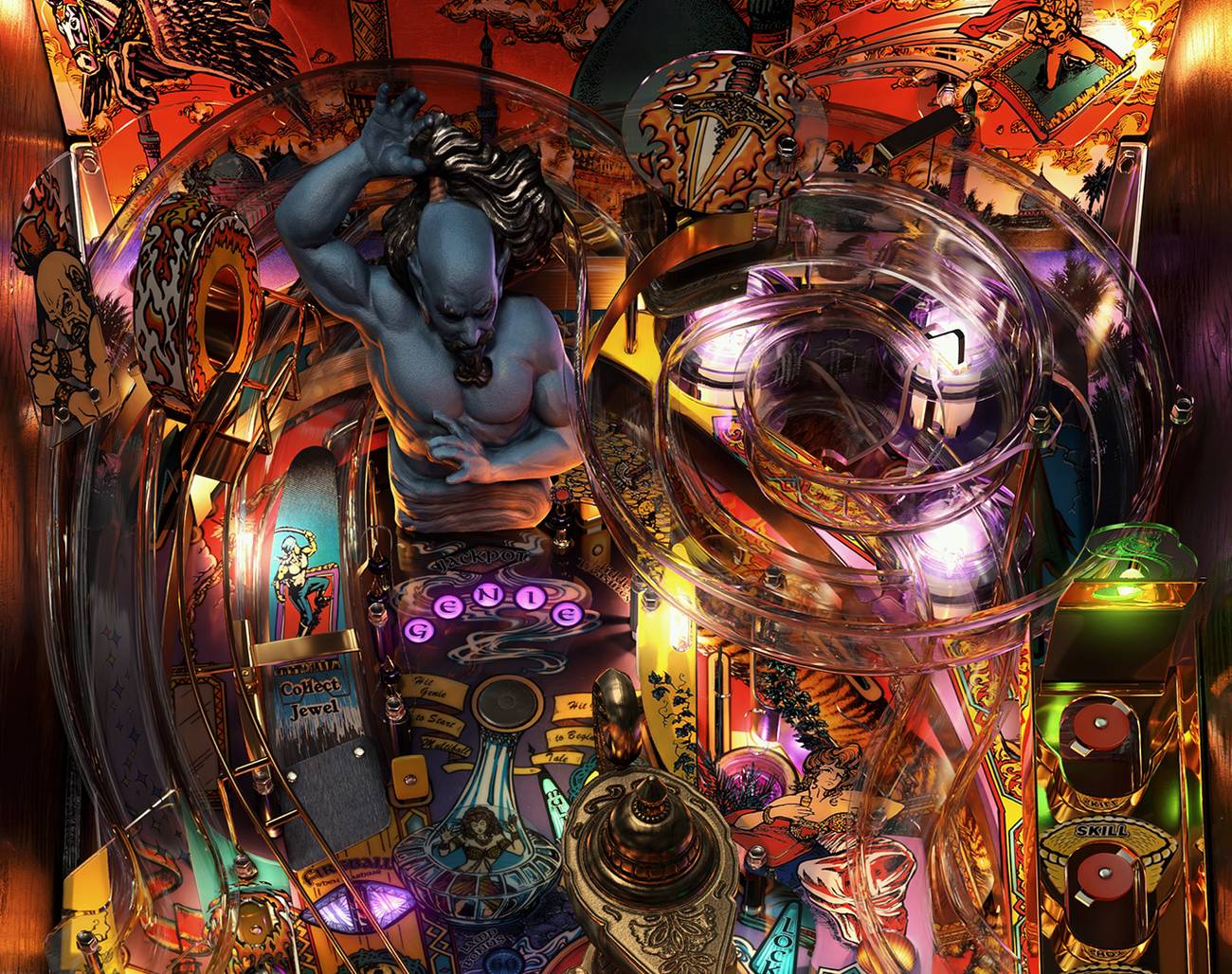
Tales of the Arabian Nights (Williams, 1996) playfield detail.
Table architecture, progressive mastery, and the digital-to-IRL pipeline.
Tales of the Arabian Nights (Williams, 1996) playfield detail.
Why pinball
Pinball takes just enough focus to quiet the mental chatter -- the to-do lists, the background anxiety -- without demanding so much attention that nothing else can happen. That's the sweet spot: engaged enough to think clearly, loose enough that better thoughts show up while your hands are busy. It's a relaxation mechanism disguised as a game of reflexes.
Table architecture & progressive mastery
Early play on any table is reaction-based -- flip at the ball, chase the bright lights. Real progress starts when you learn the intended shot sequences and ramp paths, and start to understand the logic behind why a table was built the way it was. From there it becomes about execution: perfecting a sequence you now understand instead of just surviving it.
Multiball is the ultimate test of that mastery -- precision and strategy converging in real time, with no room to fall back on reaction alone. Different tables demand entirely different strategies, which is why the same machine can still be teaching you something after fifty plays.
Favorite machines & designers
John Popadiuk designed four of my favorite machines -- World Cup Soccer ’94, Theater of Magic, Circus Voltaire, and Tales of the Arabian Nights -- and they share a quality I keep coming back to: they're architecturally intricate, layered with strategy that reveals itself slowly instead of all at once.
Other regulars: High Speed 2: Getaway, which asks for something completely different from a Popadiuk table -- raw precision, loading the pipeline, nailing the shot for maximum points, a different kind of mastery entirely. Godzilla LE for the creature-feature energy and mechanical satisfaction. Monster Bash, my regular go-to -- I play it on PinballFX on Quest 3 where it's easier and I regularly reach wizard mode, then chase the deeper execution IRL where the same machine asks something harder of me. And Medieval Madness and Attack from Mars, both from the same designer, both a specific kind of 90s architectural beauty.
Digital-to-IRL pipeline
I play across Visual Pinball on PC, Zen Pinball on Steam, and PinballFX on Quest 3. Digital play is risk-free experimentation -- learning shot sequences, understanding what to aim for and what to avoid -- and the skills transfer is real. Table architecture learned digitally carries through to physical play; the hands and muscle memory follow.
I keep the Quest 3 difficulty on default instead of setting it to Pro -- extra ball at replay, easier overall play. It lets me reach table states I can't yet accomplish in Visual Pinball or in person: wizard modes, final challenges. It feels a little like cheating, but I know exactly what it is -- an easier setting, not a different game -- and the real value is getting to enjoy elements of a table I'm not yet ready for in real life. Strategic preview and pure enjoyment, both real.
Connection to systems thinking
The same instincts that make a table click for me are the ones I bring to a broken QA workflow or a stalled platform migration: understand how the system actually works before you try to beat it, find the strategy that's elegant rather than brute-force, and execute with precision once you know what you're doing. Pinball is just the version of that with flashing lights.
Also on the About page