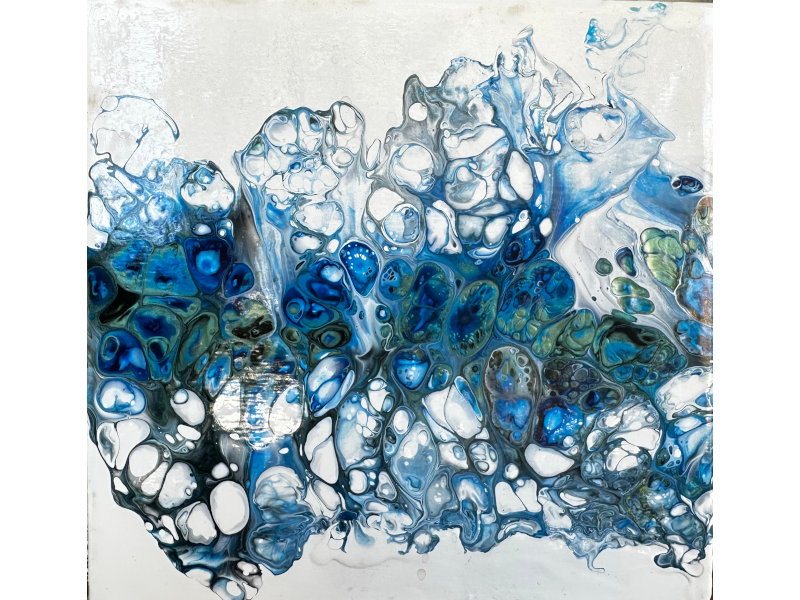
Blues, greens, black on white ground · Dutch pour · Cigar box lid · Blow dryer, cross-directional pass
Dutch Pour · Cigar Box Lid
White ground. Blues and greens on top. Air does the rest.
Blues, greens, black on white ground · Dutch pour · Cigar box lid · Blow dryer, cross-directional pass
The setup
Most of the pours in this body of work use a dark ground, color emerging from darkness. This one inverts that. The base is white fluid paint, and the blues and greens were laid on top of it as stripes. Silicone oil added to multiple colors to encourage cell development. Paint mixed thin.
White acrylic is among the heaviest pigments. It sinks. That physical fact is what makes the composition possible. The dark colors end up on top not because they were placed there, but because the white pushed through them.
The technique
The blow dryer went across the paint pool, not with it, perpendicular to the stripe direction. That cross-movement opened the cells and pushed color away from center, letting the white ground come through between them.
The white stripe on top of the color stack pushes everything else up and outward when it sinks, spreading the blues and greens in a way that thinner paint alone wouldn’t achieve.
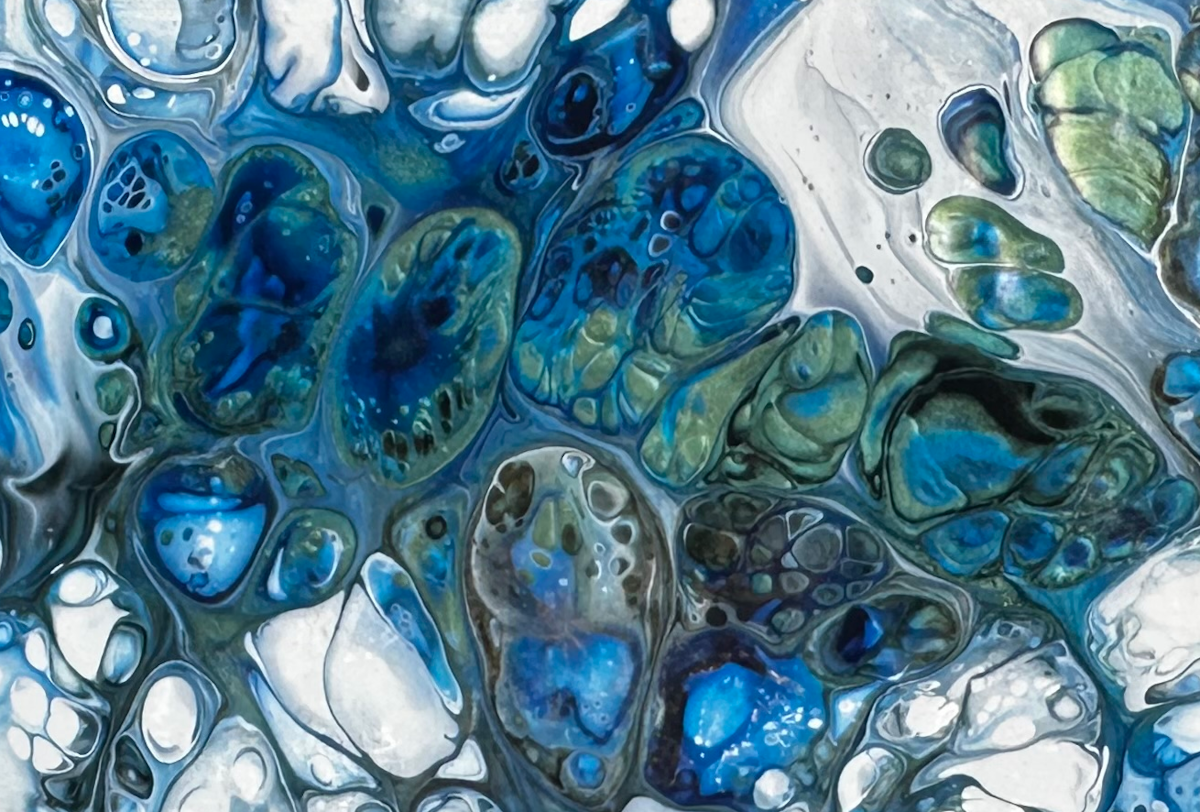
Deep cobalt and green-gold cells packed tight against the lid’s hard edges. The small substrate means nothing has room to thin out. Every cell competes for the same dense field.
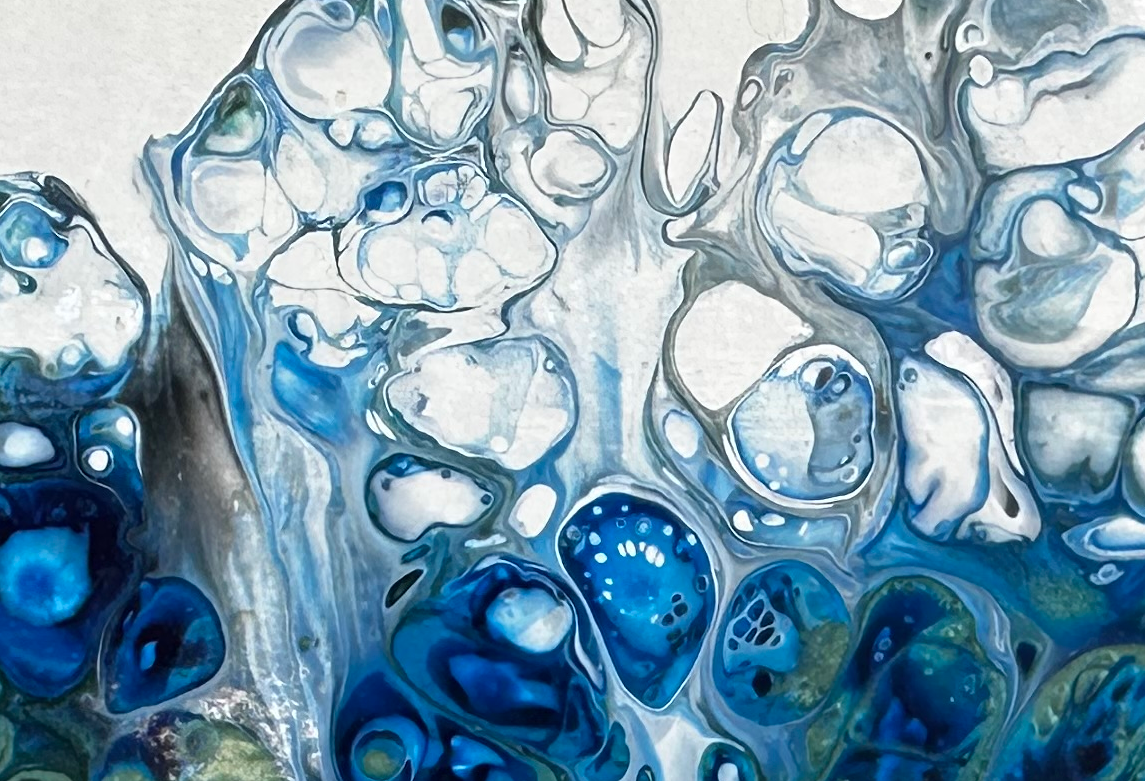
The white ground breaking through center as the heavy pigment sinks through the color stack above it. The perpendicular air stream opened this channel, and the blue cells pushed outward on both sides.
The substrate
The cigar box lid is small and rigid with hard edges. Paint doesn’t wrap around. It hits the boundary and stops. The scale of the cells relative to the small surface makes the composition feel dense and compressed. Nothing has room to thin out or drift.
The close-up reads like a reef section under glass: deep cobalt forms, iridescent green-gold cell walls, dark tessellated structures that look like something that grew rather than something that was made.