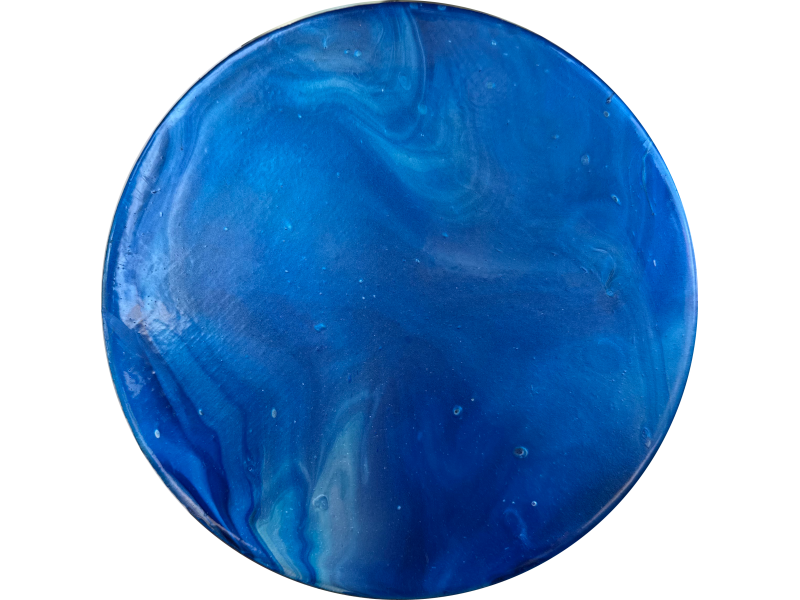
Arteza Metallic Acrylics · Leftover palette from the Bioluminescent session · Flip cup on round canvas
Flip Cup · Round Canvas
Same paint. Same session. The round canvas changed what it became.
Arteza Metallic Acrylics · Leftover palette from the Bioluminescent session · Flip cup on round canvas
The origin
This piece is built from what was left over after the Bioluminescent pour. A flip cup uses what’s left: when that pour finished, the cups still had paint: Ultramarine Blue and blue metallics, layered in the order they’d been used. Most of the silicone oil had already floated to the surface during the first pour. A trace amount remained. Enough.
I stacked the leftover colors into a single cup, inverted it onto a round canvas, and lifted. Then tilt work to move it across the surface, a torch pass to release the bubbles. The whole thing took minutes. The result took longer to understand.
The format
A rectangular canvas has orientation: top, bottom, implied horizon. A round canvas has none of that. The composition radiates from wherever the flip cup landed, and the tilt spreads it without a preferred direction.
Same palette, same session, same chemistry. But the round format removed the horizon line, and without a horizon, the result stopped reading as ocean and started reading as space.
The Bioluminescent piece has depth. You read downward into it, the way you’d read into water. This one has distance. You read outward from the center, the way you’d read a star field or a nebula. The cells are the same cellular chemistry, but in a radial field without a horizon they become something else, less biological, more astronomical.
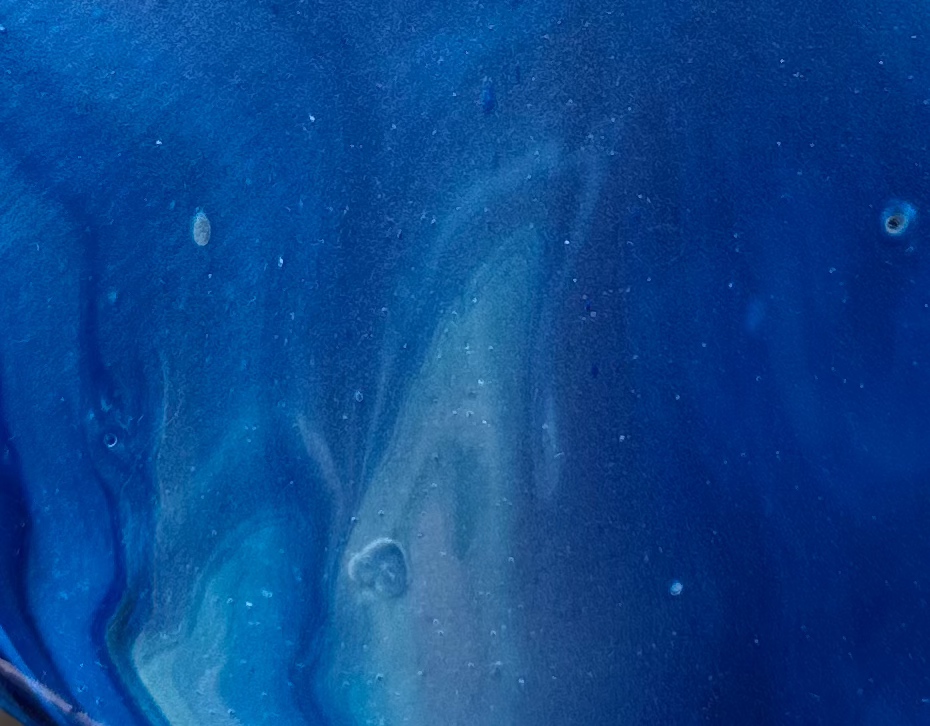
The surface up close. The leftover palette from the Bioluminescent session, same Ultramarine Blue and metallics, same silicone residue. Less cellular here because most of the silicone had already been spent in the first pour.
The connection
This piece carries the same palette, the same session, the same conversation between pigment and medium as Bioluminescent. It’s a separate work. But it comes from there.
Dutch pour · Arteza Metallics
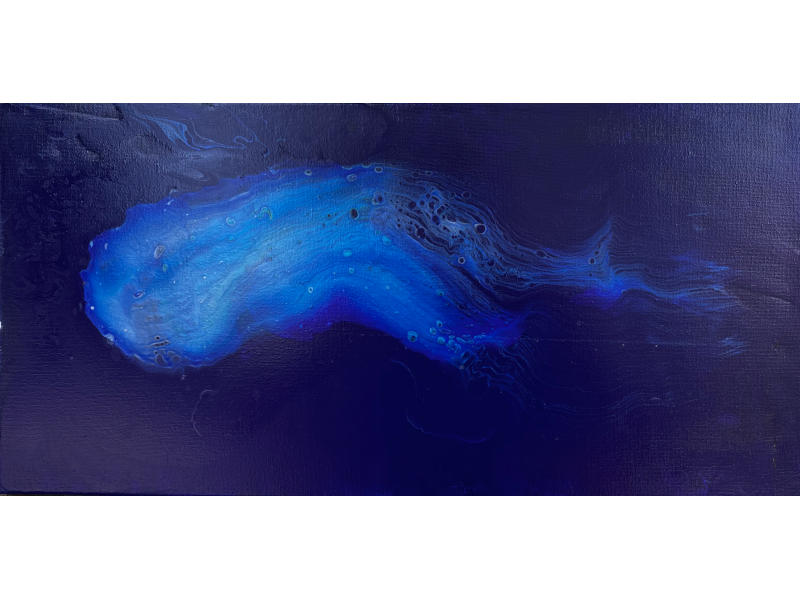
Bioluminescent
Where the paint came from. Same session, first pour.