The Problem
Learning platforms exist. They don't connect to your job search.
You can take Coursera. You can do Udemy. You can subscribe to LinkedIn Learning. All of them show you completion badges and progress bars. But they don't connect to what you actually need to show an employer: specific projects, specific evidence, specific answers to the question "can you do this?"
Meanwhile, your job search tracker is asking "do you have AI skills?" And your resume is saying "I'm learning CS fundamentals" — which is true but vague. And your cover letters need specific examples. The learning platform says "you completed week 3," but the employer needs "you built X, it works like Y, here's the repo."
So the real gap is: there's no bridge. Learning happens in isolation from the job search. You don't know what to learn because you don't know what the roles actually ask for. And once you learn it, proving you learned it requires manual translation from course completion to portfolio evidence.
The Approach
Portfolio-first learning. Curriculum that produces evidence.
Instead of starting with the course ("take CS50x"), start with the question: what does an AI engineer actually need to know, and how do I prove I know it? Then structure a curriculum backwards from that proof.
That means: a six-phase learning path (from prompt methodology through SWE discipline and certifications). Each phase is structured to produce concrete artifacts: completed projects, certificates, implemented techniques in real applications. Not just "learned it" — "built it, shipped it, here's the evidence."
This also means tracking it in a way that feeds your job search, your resume, your cover letters, and your interview prep — all from one source of truth. The learning platform knows what you're building. Your resume export knows the same things. Your application materials can reference the real work, not abstractions.
What I Built
A structured, tracked learning path with portfolio integration
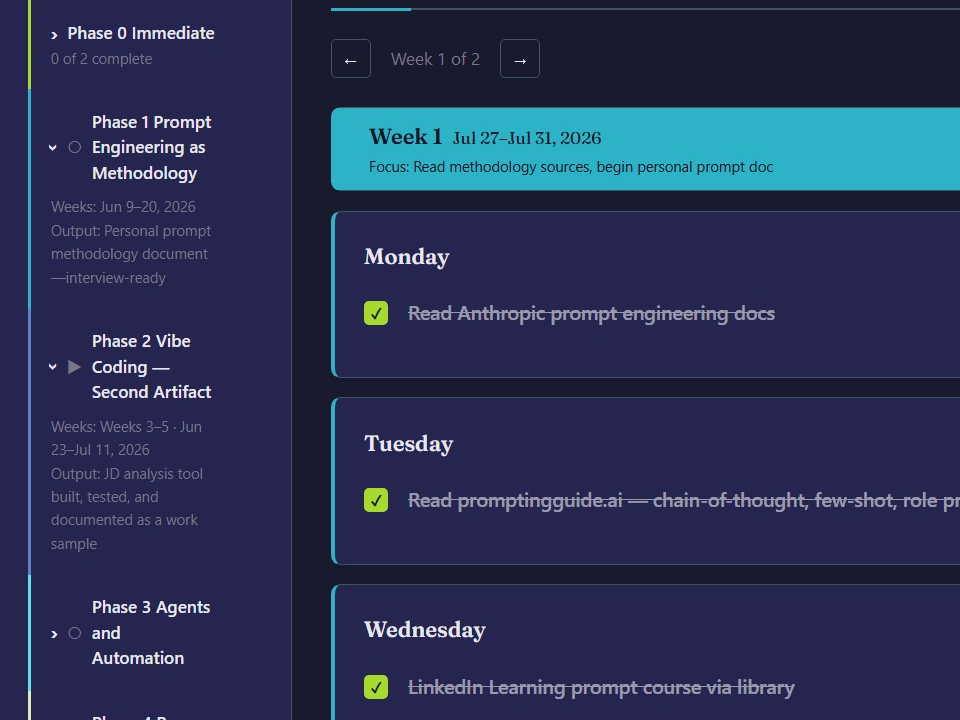
The Phases are: (1) Prompt Methodology & AI Fundamentals (validating what you already know), (2) CS50x (computer science foundations — weeks 1–12, starting Aug 9), (3) LLM Mechanics & Transformer Deep Dive (weeks 13–22), (4) Software Engineering Discipline (weeks 23–31, testing and documentation on real applications), (5) Certificates & Real-World Implementation (PL-300, AWS AI, final integrated project), and (6) AI Automation & n8n Grounding (moving automation from browser-driven scripts to production-ready workflows).
Each phase has an artifact — a concrete deliverable that shows you did the work. CS50x produces problem sets and a final project. LLM mechanics produces a written deep dive or a custom implementation. SWE discipline produces tests and architecture documentation on an existing app. Certificates are obvious. This means the platform becomes a portfolio catalog, not just a checklist.
The Tracker shows your progress by phase: weeks completed, projects finished, certificates earned, real skills validated. It connects to your job tracker — so when a role asks for "CS fundamentals," you can point to "completed CS50x, artifacts at [link]."
The Exports are the point. Pull a resume export and it shows: "CS50x, completed Aug 2026. Proof Sheets: [projects]." Pull a cover letter snippet and it says: "Built [specific system] using [specific techniques learned in phase X]." Pull interview prep and it lists questions you should be able to answer with evidence from your phases.
The Emotional Support Piece is built in: you're not just marking off weeks. You're seeing concrete projects accumulate. You're watching the resume export get richer. That's the motivation — not just "I completed week 4" but "I can now show employers that I've learned this."
Structured Path
Six Phases
Not "take whatever courses interest you." A deliberate sequence: fundamentals → depth → discipline → evidence. Each phase builds on the last.
Portfolio Evidence
Every Phase Produces Proof
Not just completion badges. Projects, certificates, implementations you can reference in applications and interviews.
Structure & Pacing
Real calendar, realistic rhythm
Pacing: 90 minutes a day, Monday through Friday. Weekends are catch-up buffers, not scheduled. This is meant to be maintainable alongside a job search and work.
Phases run at different lengths based on the actual work required. CS50x is 12 weeks (Aug 9–Oct 29). LLM mechanics is 10 weeks (Nov 1–Jan 7), with holiday weeks flagged as lighter buffer weeks. SWE discipline is 9 weeks (Jan 10–Mar 11), with a built-in decision point week 6 for choosing which app to apply testing and architecture work to.
The entire plan runs through March 2027, with milestone certificates and a final integrated project that ties everything together. By then, you'll have: CS fundamentals validated (certificate), LLM knowledge demonstrated (certificate + written work), SWE discipline proven (tests + docs on a real app), and AI certificates in the pipeline (PL-300, AWS AI Practitioner).
The Evidence Strategy
From completion to proof
Every phase tracks the evidence that matters to employers:
Phase 1: Prompt Methodology
Article or LinkedIn post on prompt engineering patterns. Public writing showing you can explain what you know.
Phase 2: CS50x
Problem sets + final project. Repo links. This is proof of foundational competence.
Phase 3: LLM Mechanics
Deep-dive article or custom implementation. Understanding transformers at a level beyond "it's a big neural net."
Phase 4: SWE Discipline
Tests + architecture documentation applied to a real app you've built. Proof you know how to write production-ready code.
This means that by the end of phase 4, a resume export can list: completed courses (with repos), certifications, real-world applications, and written technical work. That's stronger than "I'm learning AI skills."
Lessons & Next Steps
Built and launching. Testing the hypothesis.
The MVP is live as of July 2026. The platform is tracking phases, artifacts, and exports. The integration with the job tracker works — you can see how learning connects to role requirements. The export functions (resume, cover letter, interview prep) are built and accessible.
What I'm testing: whether this structure actually produces the emotional support it's designed for. Does seeing "CS50x completed with 4 projects" feel more motivating than seeing "week 8 done"? Does knowing that each project is portfolio-ready change how you approach the work? Does the job-search connection make learning feel less abstract?
I'm too early in (just beginning phase 2) to claim it works. But the hypothesis is solid: learning + portfolio + structure + connection to job search should create a feedback loop that sustained motivation through a six-month plan. That's what I built to test.
This is an experiment. I believed portfolio-first learning was better than generic course-completion tracking, so I built the infrastructure to test it. The platform is designed to prove or disprove that — to show whether intentional structure and concrete evidence actually feed motivation and job-search results over a medium-term learning plan. The next four months will answer that question.