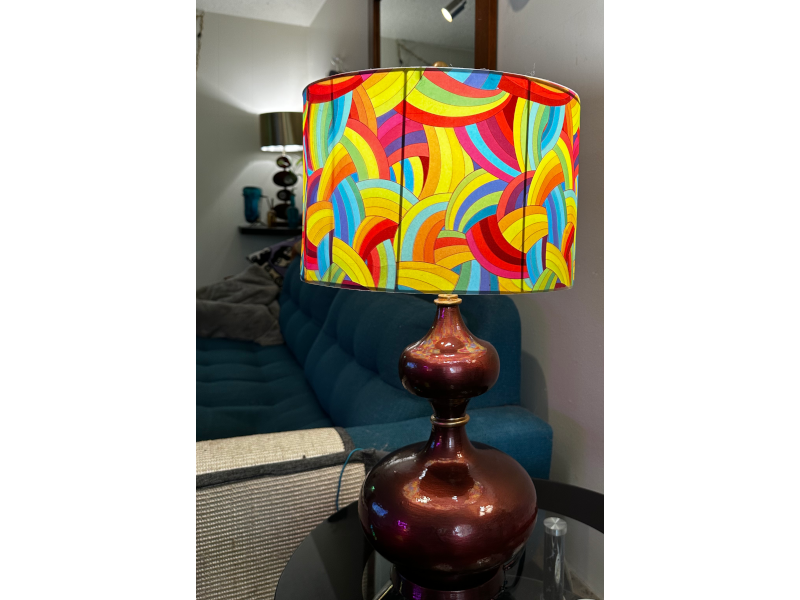
Transformation · Found Object
Wood base. Wicker shade. Neither was wrong. They just weren’t right.
The original object
The lamp came with a wood base and a wicker and seagrass shade. The base had real presence: a double-gourd silhouette, substantial and well-proportioned. The shade was doing nothing with it. Seagrass is texture without light, and a shade’s entire job is to work with light. The seagrass came off. The wire frame stayed.
The base
The wood base was prepped with gesso, then painted using Arteza metallics, mixing toward copper and rose. Rose metallic was applied along the outermost curves, following the widest contours of the gourd form. Where light hits those curves, the surface shifts. Brown becomes copper, copper becomes something that moves with the angle.
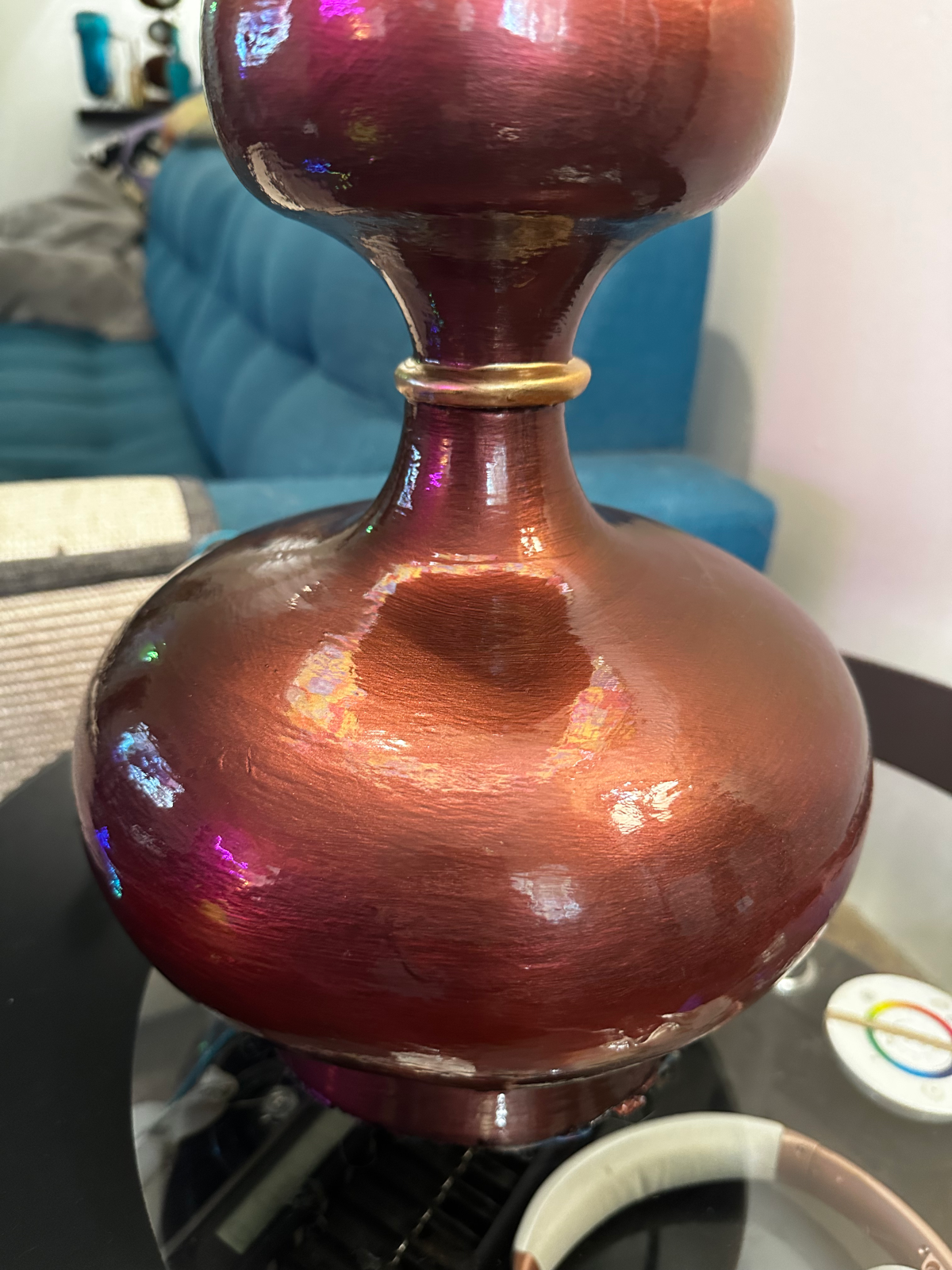
Deep burgundy shifting into copper as the light catches the widest curve of the gourd. The surface reads differently depending on where you’re standing.
The shade
The shade pattern is a tile design found online, a repeating rainbow arc motif at full saturation, every color of the spectrum. It was brought into GIMP, scaled to fit a blank shade template, and arranged into printable sections. Then the construction process began, and it turned out to have more steps than expected.
Two identical sheets of the pattern were printed. Both were oiled. The oil saturates the paper and makes it translucent, which is what lets the light behave the way it does when the lamp is on. The two sheets are mirror images of each other. They were aligned face-to-face and fixed with spray adhesive, then the joined panel was wrapped around the wire frame.
The laminating adhesive sheet gave the shade more body and weight, but it also made it too shiny. The matte spray fixed that. Both decisions are still visible in the finished piece if you know to look.
A laminating adhesive sheet was wrapped around the outside for durability and to give the shade structure and weight. The problem: it made the surface very shiny, which emphasized every minor wrinkle and imperfection in the panel underneath. A clear matte spray reduced the gloss and pulled back the plastic look. In the shade detail photo, you can see where the two layers are slightly misaligned. The doubled pattern edge is visible at the seams. It reads less as an error than as evidence of how the thing was made.
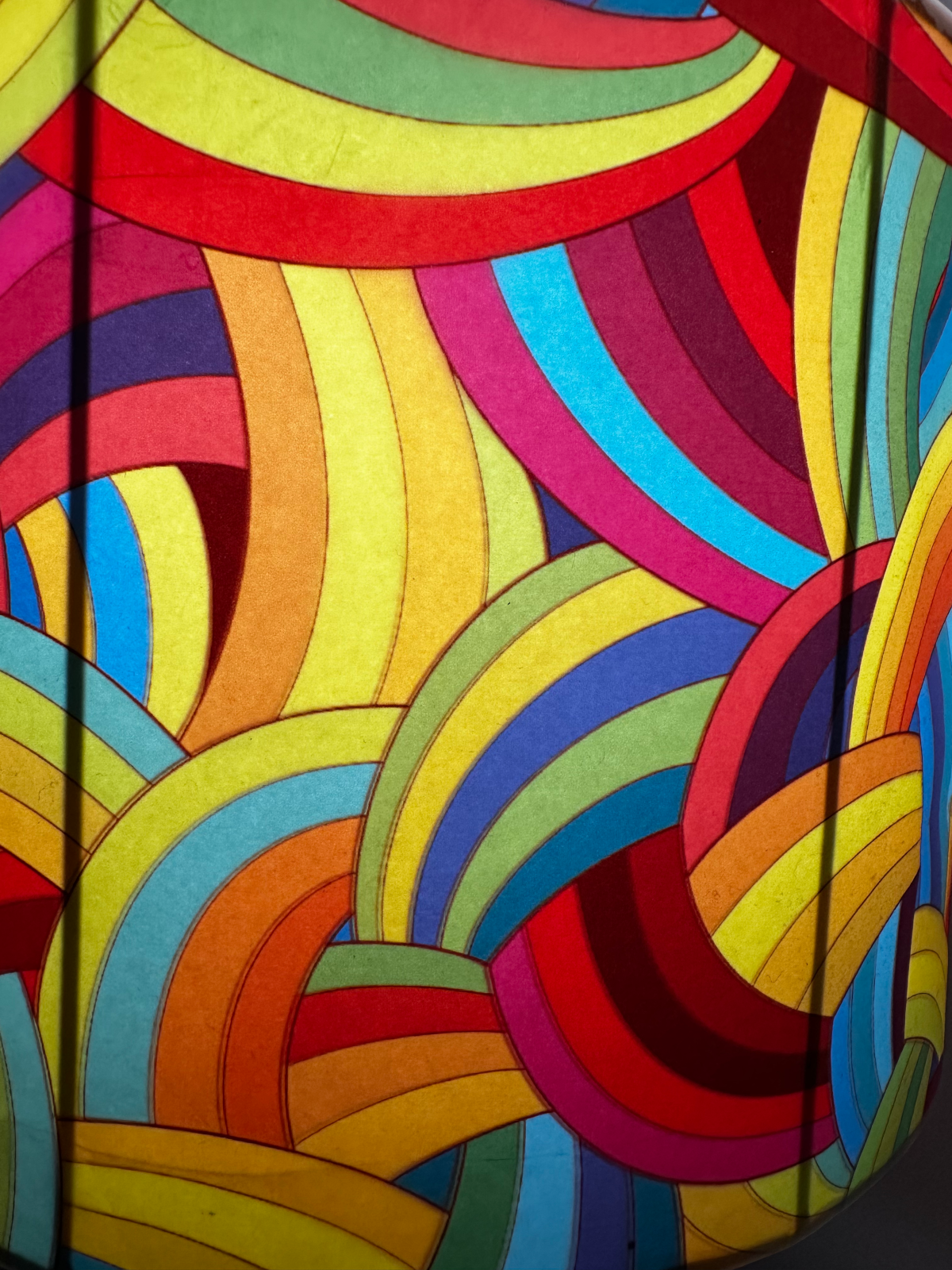
The shade lit from within. Two mirror-image oiled sheets fixed together. The slight misalignment between the layers is visible at the seams, where the doubled edge of the pattern shows through.
Where it lives
The lamp sits in the corner of the living room beside the couch. The shade is full-spectrum rainbow arcs at maximum saturation. The pattern was found that way and the decision was to not turn any of it down. The base holds its own against it: deep burgundy with copper iridescence along the curves. It is exactly what it was supposed to be.
More making